If “our” means on the US, you may have to take a look at your electricity monopolies for it to make any difference.
The US has some of the cheapest energy in the civilized world. I’m not sure what to draw from that fact, but it is clear our energy system works pretty well for the end-user.
For a counterpoint, check out Germany’s expensive as fuck energy.
You have some of the world’s cheapest electricity wholesale. You also have a huge variance in prices to end-user, with the people that complain on the internet being among the most expensive in the world… because, of course, people that get cheaper prices don’t complain.
Also, yes, electricity in Germany is expensive as fuck.
It’s also one of the oldest and poorly maintained for much of the country. As the data centers keep going up it’s making it harder and harder to meet customers energy needs.
This argument has received responses calling me a Commie, a Tankie, and ‘a would-be enslaver of humanity’ from family, friends, and internet randoms alike.
For me it is that I just… sorta listened to Bill Nye in the 90s about carbon dioxide.
I am pretty sure 90% of people who get called tankies on Lemmy are not communists. Tankie-calling is by far the most obnoxious Lemmy community pastime. But I’ll give them this, it’s an extremely annoying word, much more annoying to be called than “fascist”. We need an unjustifiably smug sounding pejorative for people who call everyone tankies, to call them in exchange so that they can see how not epic their insult is.
The key thing is that the insult needs to seem like you think it’s really badass and brave of you to call them that, and it should seem like you think they’re seething at you, when in reality it’s a super lame insult. Like so:
“You’re a tankie”
“Oh no the Tankie-twister has arrived!”
“Wtf kind of lame insult is that lol”
“Now you know how everyone else feels about being called tankies”
Does the person deny the human rights violation of USSR and China? Then they’re tankies. Simple as that.
I mean, ACAB. I’m sure you can find human rights abuses anywhere you want to look.
But what does this have to do with decarbonization? Is China’s production of photovoltaics materially more abusive than America’s production of hydrocarbons?
Then they’re tankies.
Was George Bush Jr a Tankie when he invaded Iraq? Is Trump a Tankie for invading Venezuela?
Or is the whole Blood For Oil thing Based and Freedom-Pilled?
I should add, those who defend China and USSR as if they can’t do anything wrong are DEFINITELY tankies.
those who defend China and USSR as if they can’t do anything wrong
I’ve yet to see anyone - left, right, or center - that has suggested an entire country’s worth of people has never done anything wrong in its history.
“Tankie” has a real, actual, honest to god historical definition. Its not just “people who liked the Soviet system more than the capitalist system”. Its an explicit advocacy for non-interventionism during the Cold War. Specifically, it is British progressives who didn’t want the UK sending support to Hungarian reactionaries during the 1956 revolt.
The British media portrayed any reluctance to intercede on behalf of anti-communists abroad as pro-Khrushchev puppets who wanted to see Russian tanks flatten all of Europe. That’s what a “Tankie” is supposed to mean. It’s a person accused (by anti-soviet British media) of wanting a Soviet conquest of the planet.
That’s an interesting spin I have ever seen of whitewashing crimes of communist regimes. You’re definitely a tankie.
If you definition hasn’t evolved since the 50s it might be a little out of date. That definition could draw retirement at this point.
If you definition hasn’t evolved since the 50s
How do you read English?
The reciprocal word I’ve typically seen is “liberal”.
That’s just tossing a hand grenade into any political discourse.
Do people get upset about that
I am pretty sure 90% of people who get called tankies on Lemmy are not communists
It’s funny, because the term was coined back in the 1950s to describe British progressives who opposed NATO intervention in Eastern Europe.
If anti-interventionism is what passes the bar for Communism, I suspect Lemmy might be flush with the little red bastards.
We need an unjustifiably smug sounding pejorative for people who call everyone tankies, to call them in exchange so that they can see how not epic their insult is.
A lot of people dont deserve a reply. Works great for me. I’m sure thats been me many times in the past. (And future)
Probably an offshoot of just how many tankies there are on Lemmy. Some people are definitely getting caught in the crossfire.
No they wouldn’t. Final consumer cost is based on what people WILL pay not what they WANT to pay. At the end of the day the overarching goal of capitalism is for 99% of the population to spend 100% of their earnings. You can’t funnel all wealth to the 1% if the 99% are holding on to it.
So you’re telling me if I found a way reach all my fellow power company customers we could strike and lower our power rates?
This is sounding like you’re trying to do a socialism over here.
Sounds like you don’t understand what socialism is
Many states have very regulated utility prices: you may need just a half dozen buddies and get appointed to the oversight board that approves rates
This guy politics.
Yes. It’s like big telecom. When people install panels at home, power companies start inventing additional fees. If communities start looking for local grids, companies start lobbying to outlaw this.
The main problem with that is the large power consumption by industry. This is ensuring continued profits for the company and thereby weakens your influence, similar to hiring scabs.
In the short term, yes. The money you’ve saved is now considered “disposable income” and will be absorbed by the next person in line.
If a paycheck could make you wealthy, no one would give you a paycheck. A retirement account CAN make you wealthy but only after the machine has squeezed 40+ years out of you. But one way or another that money is leaving your hands and flowing back into the system.
In a free market, people will pay less for the same service if they can.
Capitalistic utility monopolies are a scam.
Yes. BUT there are certain ways a government can help its citizens (and itself in most cases) by allowing them to be self sufficient that has nothing to do with electric companies or monopolies at all. The subsidies for solar panels were a great example of this. Depending on your personal needs, you could generate enough power to take yourself off the grid, and the government invested in your panels by way of those subsidies. In many cases the extra electricity from the panels that you don’t use can go back into a grid to be used by someone else. Theoretically helping you and the government. There are, of course some issues with the system but speaking from experience it can absolutely work and work wonderfully.
Unfortunately Trump (of course) has killed these subsidies so that will not be a thing as of new years 2026.
Ok, sure. There are theoretical and convoluted ways to disconnect from the electric grid. You’re still buying solar panels. Your out of pocket costs don’t change. The river of money still flows into and out of your life. It’s called currency for a reason. The whole system is designed to stop you from keeping your money.
The dark secret about money is that it only works when there’s isn’t enough for everyone. Despite what politicians want you to believe, you are SUPPOSED to live paycheck to paycheck- at least under a western capitalist economy. This is why poor people are both the most valuable citizens, and easiest to control. It’s slavery with more steps.
Imagine the savings to society with the energy independence from green energy
- shut down most of the continent wide natural gas distribution infrastructure
- shut down most of the continent wide gasoline distribution infrastructure
- cut way back on the military when we no longer have to protect oil kingdoms
I know your intentions are good, but this reads as a rather damning list of why a bunch of people are going to fight tooth and nail to keep the status quo.
There were recently a couple of bad gas leaks locally and it was an interesting reminder that there’s these natural gas lines laid crisscrossing the northern US that are just explosions waiting to happen. There’s been some nasty ones too
The unavoidable conclusion in today’s world is that we need to be phasing out natural gas. It can’t be cleanly turned off and back on, it’s wildly dangerous if it leaks out due to poor install/maintaince or natural disasters, it can explode if someone happens to drill into a gas line (I know a guy who did internet installs and at the time he joked about how “yeah you just drill holes into folks homes to poke the cables through and hope you don’t hear hissing after drilling”) during a house fire it just feeds more extremely potent fuel into the fire until turned off. About the only benefit is when it’s extremely cold out, such as when the destabilizing polar vortex whips through, natural gas is probably the most energy efficient option to keep homes and businesses inhabitable
Plus methane is a much stronger greenhouse gas than CO2, even with the shorter lifetime. We seem entirely unable to reduce methane leaks or even measure them against natural gas usage.
But from a consumer perspective.
- where I live, electricity is much more expensive than natural gas, maybe double the cost per unit of energy
- and I pay even more for 75% renewables
- I just got a heat pump installed for my addition. So far temps have gotten just a bit under freezing and it has no problems keeping up
But that adds up to a reality where the cost threshold is mid-40°F’s. While it may be an argument in favor of solar, I don’t have enough unshaded roof to generate more than half my usage
Reminder that China’s competent government has done exactly this, and as a result they produce 93% of the world’s solar photovoltaic panels.
Can we get the competency with out the whole… Everything else?
Or is our choice between awful and ineffective or awful and effective?
What’s the awful everything else? China has consistently some of the highest government satisfaction rates in the world
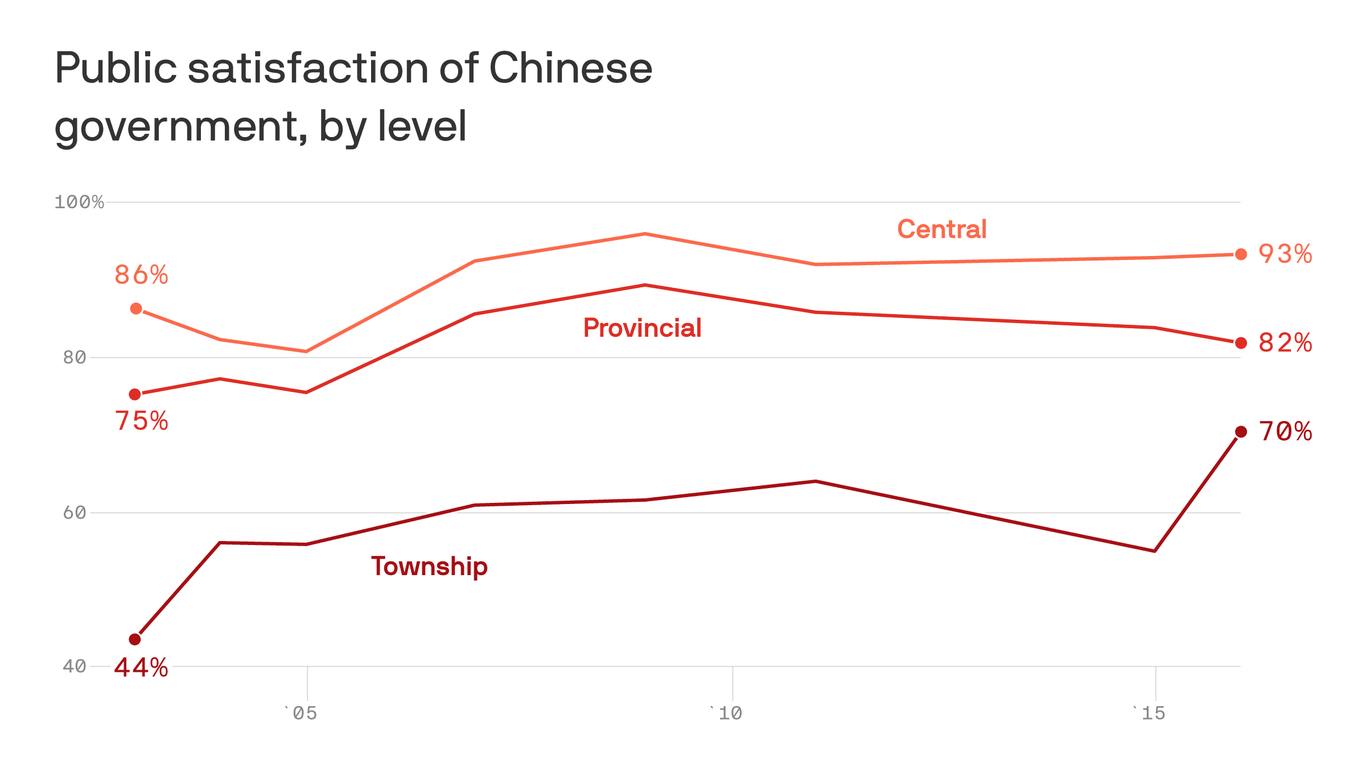
As a Spaniard, it’s hard to conceive 90+% of the population being satisfied with the central government, everyone here hates our government and politicians.
Are you sure you’re speaking for Chinese people when you criticize whatever “everything else” you refer to?
“When you have them by the balls, their hearts and minds soon follow”
John Dean
So 1.4 billion Chinese are essentially suffering Stockholm Syndrome from the evil Chinese Government, and their satisfaction rates have nothing to do with the consistently increasing living standards?
As a Spaniard, you should ask your parents and/or grandparents if in Franco’s day they would really tell their real opinions about their government to some random person doing a poll.
Government satisfaction data in an autocracy is always going to be poluted because people fear their words might reach the ears of somebody in a position of authority and them being punished in some way for being critical of the government, so they keep it to themselves and share it at most with family and close friends.
(And this is before we even count the effects from people’s main information sources being highly controlled in such regimes, so literally they might think other countries are shitholes compared to theirs because that’s what newspapes and TV tell them. Even though people are quite a lot more cynical about the “news” in such regimes - one of the Soviet times jokes was “There is no pravda [truth] in the Pravda [the newspaper], there is no izvestia [news] in the Izvestia [another newspaper]” - such total control in aggregate still pushes public opinion to be better than otherwise).
People have no such need to keep their mouth shut in Democracies. Further, I would even say that in Democracies people are incentivised to be loudly critical - those who support a different political party than the one in power tend to be loudly critical purelly out of tribalism, same as they would criticize the other team in a footbal match even if that team was playing well.
All this to say that we don’t really know how much people in China are satisfied or not with the authorities there because smart people living in a autocratic regime know better than to voice criticism of those in power, which polutes the data, whilst in Democracies political clubism also probably polutes the data but in the opposite direction.
Your comment can be wholly ignored by explaining to you that the surveys I refer to are done by western institutions like Pew Research, the University of California or the Ash Center for Democratic Governance (source).
You, as a westerner, believe your western propaganda that China is an antidemocratic autocracy where people can’t give their political opinions freely. Chinese people simply don’t feel that way as per any serious study, and your opinion can be safely ignored because it’s based on your misunderstandings as a misled westerner.
I happen to live next door to Spain, in Portugal, and I did ask my parents and older friends (some of which who are very leftwing and were Communists back in the days of the Revolution) and back then in our own Fascism (which ran parallel to Spain’s) nobody would tell their true opinion about the government to a stranger, much less a stranger claiming to be doing a poll for some university in a country which is viewed and views itself as an adversary of your own country.
Hell, in such a setup people would loudly tell the foreigner (or local working for those foreigners) just how great their government was just in case that was some kind of sting operation by the secret police or what you said leaked out: back when even your neighbours could rat you out to the secret police for saying something critical of the regime, criticizing the regime to somebody claiming to be doing a “poll” like this was a good way to end up a political prisioner (and, unlike those hailing from the middle class, politicial prisioners from poorer families didn’t get the velvet glove treatment, and most people were poor and working class).
So, it’s strange you didn’t ask such things from older people in the country you claim to hail from…
That and given how you phrased…
You, as a westerner, believe your western propaganda that China is an antidemocratic autocracy where people can’t give their political opinions freely. Chinese people simply don’t feel that way as per any serious study, and your opinion can be safely ignored because it’s based on your misunderstandings as a misled westerner.
all sounds a lot like you’re not a Spaniard. Which would make your earlier statement:
As a Spaniard, it’s hard to conceive 90+% of the population being satisfied with the central government
a lie.
Guess who would try and pass themselves as a “westerner” to seem more trustworthy in a forum mostly frequented by “westerners” when defending China?
A propaganda astroturfer.
(Funilly enough, there’s a ton of anti-China propaganda in the West, especially in the US, it’s just that this time you seriously overplayed that as a card when you tried to whitewash your own propaganda with it)
PS: Oh and just to point out how much that “westerner bias” bollocks applies to me, just after I made that previous comment on your bullshit, I made an equally critical comment on some other muppet from the “other” side talking about “China’s attrocities”, and that comment of mine definitelly sounds like pro-China to any simpleton tribalist moron or propaganda sockpuppet.
My biggest “bias” in this is against Hipocrisy and Propaganda.
It’s great being comfortable while your government is committing atrocities. Cozy cozy!
Waiting for the day someone finds a government who doesn’t commit atrocities.
In a field of shit, pointing at a specific turd and shouting “Look at that shit” is at best redundant, at worst sleazy propagandistic and hipocrite bollocks.
China’s present day level of support for atrocity is nothing compared with most of the West’s active support (diplomatic, economic and even with weapons) for the the present day equivalent of the Nazis committing a Genocide in Gaza.
Even what Russia is doing in Ukraine (with the support of China) is nowhere close to that shit if measured in terms of civilian casualties as a percentage of the population (even if including military casualties, it’s still well below the levels of bloodshed in Gaza).
We would need to go back to the time of Mao to find China supporting atrocities at such a level.
That “atrocities” flag is best waved from the top of the moral high ground, not from the top of a pile of Palestinian children’s bones.
Are you talking about the EU-supported genocide of Palestinians?
They might’ve meant USA.
China has consistently some of the highest government satisfaction rates in the world
it’s hard to conceive 90+% of the population being satisfied with the central government, everyone here hates our government and politicians.
You’re so close to tripping over the fact that authoritarian governments can’t be trusted to provide honest answers. Who wants to say you’re unsatisfied when doing so could get you vanned?
One of the biggest government contractors in China is the company that conducts polling.
How do you tell the difference between an authoritarian government and a government that is responsive to public sentiment but also happens to be on diplomatically shaky ground with your own leaders?
I mean I would be skeptical too of any piece of info that comes from China, but how does that coincide with only 44% of “Township” people being satisfied 10 years ago?
I’ve given my sources in other comments and they’re all western institutions. Your inability to believe them comes not from reasonable skepticism, but from western propaganda giving you cognitive bias against anything positive coming from China.
China has literally a fascist government. Authoritarians that seize corporate control for nationalistic interests while still deferring to original private property owners.
Cult of leadership is typical too. Which includes the satisfaction of citizens.
Makes me laugh when people here laud China. Especially when they’re commies who fell for the lie that China is communism.
Remind me. What happens when you speak ill of the government there? You think that might affect polls?
Ill freely admit China has many strengths… but it is definitely authoritarian also.
You think that might affect polls?
Polls carried out by Pew Research, University of California and other western institutions. Too communist for you?
What happens when you speak ill of the government there?
For the most part nothing, you may argue there’s a degree of censorship on Chinese social media, but if there were political prisoners for having “the wrong opinions” in China we wouldn’t hear the end of it. There’s nothing like Russia’s Navalny in China.
China has consistently some of the highest government satisfaction rates in the world
Surveyman: Hello random Chinese friendo, how is life under the glorious CCP?
Random Chinese friend: Can’t complain.
Surveyman: China has consistently some of the highest government satisfaction rates in the world
You can question the methodology, I’ve already given the sources in other replies if you’re interested (which links to several different studies, all carried out by western organizations such as University of California or the Pew Research Institute). You’re just not really interested, and you will reject the information because your cognitive bias tells you to.
awful and effective?
It’s bad to do green energy when you’re Chinese because… ?
It is what it is. The world is arguably better with them than without
You can’t say bad things about the government in China.
This might sound like an absurd restriction of free speech, but consider that it’s also considered highly illegal in germany to ask for the abolishment of democracy. Many far-right groups do this, and the Verfassungsschutz (basically a kind of special police force) keeps a close eye on them because of that, calls them “verfassungsgefährdend” (going against the constitution). Monarchies like england had similar laws around 1900, where you could say everything except talk badly about the monarchy in power. That was known as the “english liberalism” because in many other countries, you could say even less. China does the same today, just that instead of the german constitution or the english monarchy it’s the Communist Party.
Would companies make it cheaper or would they keep the price and pocket the profit?
They can’t, if you have a functioning market economy. There should be competition and renewables, due to their more decentralized nature even incite competition.
You seem to assume that mergers and acquisitions are not an essential part of a market economy. Left to their own devices, capitalists will always end up trying to form monopolies. You need a strong regulatory state to keep them in check. But then because they are inexorably pulled towards maximizing profitability, they will try to capture the state and deregulate. So, unless you go to a very aggressively anticapitalist set of policies a market economy will never be “functioning” for long.
I don’t assume that, and I won’t argue for an entirely free market. I also agree with your observation that accumulation happens, however we might have different views on how long that actually takes. Atm the shift to renewables is disrupting the accumulation we already have in the energy sector, because it requires very little capital to build your own little solar powerplant compared to a fossil or nuclear powerplant (or large hydro, btw.). Same thing for battery storage units. So with renewables, there’s more potential for competition.
That might change again in the future through continued accumulation and shitty policies, but my point is: as long as we don’t have either monopolies or cartels and thusly competition in the market still exists, even large corporations can’t simply dictate prices to increase their margins.
How about this: “a functioning market economy” is only possibly with strong overshight of a greater authority than “the Market”, which puts the interests of citizens above the interests of businesses.
If left to their own devices the Free Market only ever exists in low barriers to entry and low economies of scale markets, like teddy bears or soap, not in markets were it’s much harder for new entrants and being bigger is always better - and energy generation until recently was very capital intensive and required big power plants or dams located in very specific places so was not a flat-playing-field size-agnostic market and tended towards monopolies and cartels.
Even nowadays with solar, even in those countries were personal generation is viable unless governments have intervened and force it to be otherwise there are barriers for individuals and small companies to sell their self-generated power (for example were I live they get 1/4 of the price selling than they do buying), which are a mix of cost barriers to entry (the cost of a proper converter on top of the cost of the additional panels if you want to go beyond self-consumption), financial structures dominated by and best suited for large companies (mainly the wholesale and consumer markets being separate, with the large companies sitting in the middle and extracting rents from being an intermediary) and even regulatory barriers to entry (the product of governments activelly legislating and regulating to benefit the large energy companies).
I’m confused, how does this help shareholders?
No, no, you can’t have green energy until corporations figure out how to make just as much money off it as they do fossil fuels. Don’t worry though, they’re innovating. Last summer some prick about had my dad convinced to pay him to put solar panels on his roof and then also continue paying for the power those panels generated.
Nuclear is also a good option. It has the potential to scale up to our generation needs faster than green energy, and it can still be environmentally clean when any byproduct is handled responsibly.
Do I trust my government (USA) to enforce proper procedure and handling? Not really… but I do think we’re less likely to have a nuclear accident in the present day. Modern designs have many more fail safes. And I think it’d still be much cleaner than burning fossil fuels.
I think they need to coexist, though. I think a goal in the far-future should be a decentralized grid with renewable energy sources integrated wherever they can be.
Basically the one nation I would have most trusted to handle nuclear safely, Japan, couldn’t even do it. The issue these days is not that the plants themselves are unsafe, it’s that we live on a active and changing planet, and accidents can and will always happen because of so-called acts of God. The problem is that nuclear, when it goes bad, tends to go mega ultra bad in ways that are very environmentally destructive and heinously expensive to clean up. So even if there is only 1/10000 the accident rate at nuclear plants that there are at other power plants, the consequences can be a million times worse.
Why is your model for nuclear Japan? China is the world’s forefront of nuclear energy research and development, keeps expanding its capabilities, and has a clean record with no accidents.
Regardless, you’re overestimating the damage that nuclear has done in comparison with other energy sources. You could have one Chernobyl per year and you wouldn’t come close to the death toll coal or oil have worldwide. Regarding Fukushima for example, since you brought up Japan: some recent studies suggest that more people have died as a consequence of the upending of their lived by the evacuation of the whole region, than would have died according to realistic statistical models of radiation damage to humans. The main problem is that fossil fuel lobbies have successfully made people completely intolerant of radiation damage while they happily live in cities breathing in NO2 and particulate matter without one complaint.
Yeah one really nice thing about nuclear is it’s very easy to safely hide all the waste away for 20-60 years and pretend it’ll never leak or cause issues for anyone in the future, but then you get a https://en.wikipedia.org/wiki/Hanford_Site
Wow, an energy source which sometimes has increased cancer rates in its vicinity due to pollution? Thank golly all other energy sources don’t have such problems!
thorium is nuclear too… (and doesnt seem to have the same runaway problems!)
Love me some Thorium! It doesn’t address every natural-disaster type of concern as far as radiation leaks and environmental contamination, but is absolutely the better choice over Plutonium/Uranium in terms of meltdowns and nuclear waste.
Humans would never cheap out on health and safety, or reduce regulatory red tape just to try to bring costs (and maybe, though less likely, prices) down. Unheard of.
Would you feel better about nuclear if we expanded these rebreeder reactors I’ve heard of (uses spent nuclear waate) to the point there is no spent fuel sitting around?
yeah if we could not stick shit in the ground that remains deadly for thousands of years, with containment solutions designed to last 20-60 years, that would be great. But we just keep pretending this stuff is cleaner than it is because we’ve learned how contain the waste safely for about a single human lifespan. But just read about the slow-motion disaster that are the US nuclear superfund sites and you’ll see that you can put off the consequences of this waste for so many decades before it comes back around. And there is no waste-free nuclear tech at this point, just less wasteful.
Also you can vastly reduce the amount of battery capacity needed by having pilotable sources of energy like nuclear, hydro, geothermy and such
Except nuclear is not very pilotable. More than Solar or Wind. But can’t really be turned off either
Sure hydro is a lot more pilotable, or better yet, batteries.
But actually, turning it off 100% is probably the least important property of pilotable plants : you almost never need that. What does matter, however, is that those plants can be engineered to generally follow the daily demand curve and France’s plants can do that at the rate of about 1% per minute.
Thankfully that is going to happen anyway through simple economics. Fossil fuel extraction is functionally already a peak technology, out of which every bit of efficiency has been squeezed by over 100 years of frantic and lavishly funded scientific development, whereas solar, battery, and wind technologies have been absolutely plunging in $-per-Kw to deploy and have much much further to go. So governments can try to slow this down as much as they wish, but it’s as much a fool’s errand as trying to rescue the horse industry in about 1920.
Now as for the question of “why isn’t this more efficient technology resulting in savings for, me, the consumer?” I can only encourage you to look at the entire history of extractive, investor-driven capitalism for the answer.
Yeah, oil used to be the cheapest energy source for most situations (with the notable exception of mass power generation, were coal - an environmental even worse fossil fuel - was cheaper), but over the last couple of decades due to pressure on both the supply side (the easilly and cheaply extractable stuff gone) and from competing energy sources (like solar and wind-generation) oil stopped being one of the cheapest energy sources and it was pushed into just those uses were its high energy density gave it an advantage (i.e. transportation).
With better battery technology even that advantage is being lost (so electric cars are becoming the standard), which leaves only some chemical synthesis processes as places were oil is the best option.
Coal was kind pushed out of most of its markets long ago (hence you don’t see that many steam trains around) so it is mainly used in power generation, and the falling cost of solar is making coal uncompetitive in it.
Gas is a little behind oil, with its main uses being domestic heating and cooking - now transiting to electric - and power generation - where renewables are now cheaper.
The trend for fossil fuels has been obvious for decades but there is naturally a TON of inertia in the pricing changes actually resulting in the needed infrastructure changes to transition away from them plus the Economic interests which extract rents in those areas are very literally paying politicians to delay this change as much as possible hence phenomenons like many more rightwing political parties pushing anti-renewables policies.
Bold of you to assume the government cares about you at all.
Maybe it would also be much cheaper if “your” houses were a bit smaller and had proper insulation…
I wish!! Unfortunately, I didn’t build my house.
Have you considered inventing a time machine, going back in time, becoming a general contractor, and then building your house but smaller? Smh, people won’t go the slightest bit out of their way to make things better these days.
I think it would cost trillions of dollars to rebuild all houses to be smaller. Imagine the carbon footprint of that endeavor.
Not sure if you’re referring to USA, but the energy code in the US is quite strict. Since the 80s insulation has been required and in the last 20 years the code has tightened to be quite strict. Homes in Latin America have none, no energy code, and European housing stock predates these requirements. Doesn’t mean US homes don’t consume a ton of energy but they are probably way better insulated than average.
Hilariously my 1200 sq foot 125 year old home is much less energy efficient than my in-laws 3000 sq foot 3 year old home due to the greatly improved insulation and sealing practices in modern structures. On the other hand my house is so drafty I don’t have to worry about things like mold growth due to improper vapor barriers nor the air becoming too stale due to insufficient circulation
Both Europe and US are big enough to have a huge variety in building codes for different climates in different states/countries.
Its not all about insulation though. A terrace has much less exterior wall than a row of spread out detached homes. Some still insulate the party wall. but more for sound reasons. But the main advantage of terraces , fossil fuel-wise, is that the medium-density is more likely to give you a walkable grocery + other stuff and a somewhat useful bus service or other public transport.
Though modern suburbs here can be pretty sparse too with more detached homes.
Lower prices? Yeah, I’m sure they’ll get right on that…
They don’t want it to be cheaper. This is a nice upwards funnel of wealth for them.
What’s the context of the painting?
Norman Rockwell. He did paintings of Americana. This one is about the civic duty to speak up or something
Reverse image search is a powerful tool
Holy shit, I always just assumed it was John Brown
It does look just like John Brown
He looks real good, for having been a’mouldering in the grave for 70 years!
Which reverse image search do you use? I use Tineye.
Lemmy be damned, but I usually just use lens in chrome.
Removed by mod