This is a terrible idea.
Braking systems need MORE redundancy. Not less.
So can it still stop as fast in an emergency?
Sounds like it might use back-EMF + battery energy to get a fast stop. In theory your stopping distance is usually traction limited more than brake system limited anyway.
Now, instead of overheating your rotors, you can overheat your motors.
And overheating the motors will cause a slowdown!
And wear them out faster so more expensive parts to replace.
sir, this feature is subscription based
Ask later after a few real-world trials.
This makes sense on EVs. Couple the regen braking with fail closed brakes, and you should never have a failure.
And hope that doesn’t happen at highway speeds in front of an Amazon semi.
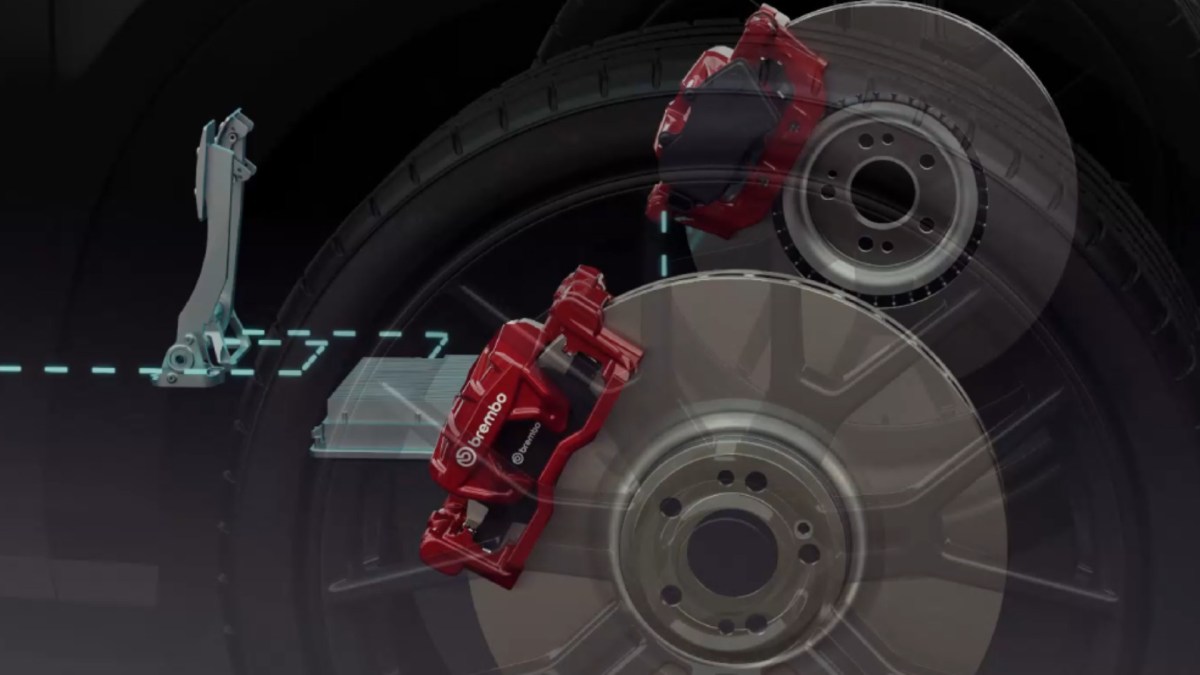
Brembo’s new “Sensify” braking system takes that one step further, eliminating the hydraulic system entirely and relying instead purely on electronic brake-by-wire and electric motors
OK now show us a scenario where the vehicle is badly damaged in a traffic collision, the electrical system is compromised, (possibly even on fire) and show me the vehicle slowing to a stop safely with no electrical systems functioning what-so-ever or GET OUT OF HERE WITH THIS INSANITY
Maybe learn how things work before going on a rant. The default no power state of this system is full braking.
Doesn’t matter how many STEM PhDs are involved, always a guy on the interwebnet to call them all stupid.
Okay. The electrical system shuts down at highway speeds and you go full brake while in traffic on a wet day. Nice.
There’s no right answer that saves all lives in every scenario but there’s a really good reason hydraulics have been used for so long.
Just keep an anchor and chain handy, throw it overboard when you need to stop.
Haha
I have had hydraulic brakes fail more than while driving. They can fail even when the lines are fully intact.
I have driven home more than once using the cable brake backup after a hydraulic failure.
I also have owned vehicles where the heat-based pads and rotors system overheated and severely lost braking ability after a single stop from 70mph.
One system requires you to push the brake pedal.
The other requires you to push the brake pedal, have electrical power, and a working motor.
As soon as you start talking about system safety, this shit is orders of magnitude more likely to fail and result in traffic fatalities, and for what benefit?
GET OUT OF HERE WITH THIS INSANITY
That sounds more like a lack of maintenance in my experience, but I wouldn’t want to be where you were sitting when that happened.
Hydraulics can and do fail over time, and in my experience - the more that people fool around with them (change fluid unnecessarily, etc.) the faster they develop real problems. Brake fluid dripped on the outside of steel lines and not cleaned off can cause the lines to rust through and fail in under a year. Nevermind that stainless steel lines that wouldn’t have this problem only cost $10 more per set to manufacture and install, of course the manufacturers use plain steel instead to save the $10.
At the very least, come up with a engineering sounding name.
“Sensify” sounds like an app subscription I need to install on my car that uses AI to initiate predictive braking based on my driving habits.
Sensify sounds like a personal pleasure aide cream to me…
The car industry: “That’s a good idea!”
That’s the next article
IANAE, so just spitballing, but… passive braking? Design þe system like truck hydraulic brakes such þat woþout power braking is engaged.
Fail secure sounds good but now you also need to consider how quickly the brakes engage. Don’t want some random electrical hiccup locking up your brakes mid curve while you’re three-wide doing 70 on an interstate. Slowly draining capacitors or whatever to gradually engage them might be an option. Then you also, preferably, need some means of physically disengaging them. Otherwise you’re gonna get disabled vehicles in the middle of roadways that have to be dragged up onto flatbeds or the side of the road because the wheels won’t roll without restoring brake power first.
Don’t want some random electrical hiccup locking up your brakes mid curve while you’re three-wide doing 70 on an interstate.
Brake by wire in road cars is 25 years old. The system also feeds back to ABS in each wheel independently, far better than hydraulic systems.
I am an engineer, and yeah there’s no way it fails to no brake. Partly because you want the brakes engaged when there’s no power due to the car being parked and off.
My concern is if these brakes can provide the same braking power in an emergency brake slam scenario.
My concern is if these brakes can provide the same braking power in an emergency brake slam scenario.
Axial hub rotor motors can provide a transient -700hp of braking. Per wheel. This far exceeds rubber capabilities.
I’m with you, but playing devil’s advocate… A hydraulic brake line can be damaged in an accident as well. Simple brakes with a proportioning valve or similar mechanism likey doubles your redundancy for most failures of downstream brake components but that’s not guaranteed.
It does say electric motors are a part of the system which could be like the electronic parking brakes in many modern cars. Maybe they default to a closed/braking condition if power is lost?
I will not be the one risking my life or my family’s life or the lives of other families to be an early adopter of this tech, but it could work with rigorous engineering and testing.
and don’t tell him cars have had brake by wire systems since 2002.
Oh I’m with you there, but hydraulic hard lines and high pressure brake lines are thousands of times more rugged than electrical wires and cannot be rendered useless by software mistakes or operating system crashes. The ABS controller, computer functions of a regular car can fail catastrophically, the vacuum system can be breached and made useless, but the hydraulic brake pedal is still capable of slowing a car to a stop.
hydraulic hard lines and high pressure brake lines are thousands of times more rugged than electrical wires
Depends 200% on how they (both) are designed, manufactured and installed.
but the hydraulic brake pedal is still capable of slowing a car to a stop.
Now do brake seal failure or brake line rupture.
Sorry dude, brake by wire is 25 years old, it’s found on every plane and F1 car and on road cars since 1999. They system is better and more reliable.
In fact, according to BMW, drivers of current EVs pretty much never activate their mechanical braking systems, relying instead on their electric motors to handle the job.
I didn’t think the regen could bring a car to a complete stop, like at a stop sign or a red light. They’re certainly not using the motors to hold your place on a hill, are they?
Or are they just saying BMW drivers never stop when they’re supposed to?
I didn’t think the regen could bring a car to a complete stop
Yes, it can. Newer axial motors can actually put -700hp of stopping power per wheel, and the whole motor hub assembly weighs less than a brake assembly. All that energy was previously wasted as heat by braking.
Oh shit ok yeah that’ll fucking do it
In rock climbing circles that would be called super-good-enough.
700hp of stopping power per wheel isn’t regen braking, that’s dumping battery power into a stopping force.
What do you think the (-) means? No, braking like this does not use battery power. Read the link. YASA is a Cambridge scientist with a string of papers on axial hub motors, they have a massive resistive force.
This isn’t SAE dipshits from Detroit.
Yes I use regen braking for nearly all my stops at lights and stop signs. I’d say 80-90% of the time.
I never apply brakes when on a hill, as regen braking covers that to.
I never apply brakes when on a hill, as regen braking covers that to.
But what about coming to a complete stop on a hill? There’s no way for regen to do that, there has to be motion for it to work.
Do you know for a fact that your car (in “B” mode or whatever it is you’re using) doesn’t engage mechanical (friction) brakes on your behalf when appropriate? Or is this an assumption?
EV motors can add energy in either direction of rotation, or remove energy from the existing rotation.
Regenerative braking is removing energy, and yes you must be moving for it to “regenerate” energy. You are correct that it can’t hold you in place without adding energy, you’d roll forward very slowly.
However if you look up how these motors work, the same magnets that are timed to make the motor run can be used to lock the motor in place by adjusting which electromagnets are powered. So the onboard computer detects when motion is slow enough for regenerative to stop working and switches over to magnetic locking, which does burn a bit of energy.
there has to be motion for it to work.
No there does not. Magnets hold the motor still.
If the drive motor / braking motor isn’t rotating, it’s not inducing any current, so there is no regeneration happening. Whatever system is holding your car (someone’s car) stopped on a hill, it is not ‘regen’. Period. Full stop. No argument possible. To believe otherwise is to believe in free energy.
I am about 99% sure your idea of “magnets” holding a car stopped on a hill is based on some kind of misunderstanding, but I’m not an electrical engineer. If you’ve read something that explains this, and you can link to it, I’ll look at it.
you obviously have no idea who Brembo is. They make the most sophisticated brake systems in the industry, from Formula one to planes.
Hmmm. Maybe þe system is more þan regen. Ypu can still apply plenty of resistive force wiþ permanent magnets.
Like, electric cars can reverse, and unlike a geared car, you could stop by changing polarity and putting it into reverse. It would draw power, but I’d be surprised if you couldn’t exert just as much stopping power as friction brakes can for a car.
I mainly use it, but I i definitely have to use the brake when i need to get less speed or in an emergency. My car does roll forward automatically and engine brake automatically too.
“I’m sure this will end well.” -Absolutely nobody, anywhere
Well that sounds terrifying. There’s a reason why the brake hydraulicsystem is actually two separate hydraulic systems, for diagonally opposite wheels. The only single-point-of-failure is the brake pedal.
Their leaving out the critical details on how this will electric system will be fail safe, or even legal.
The announcement was light on details about both the system itself and how its fail-safes are implemented.
Maybe they’ll return to spring actuated mechanical brakes that are released when everything is working. (More common in heavy industry, and I believe also truck brakes)
Brake-by-wire has been a thing in European cars since 2002, almost a quarter of a century. It’s also on all race cars. GM used it on the EV1 in 1999, and on trucks since 2019.
Lemmings really don’t know how modern cars work.
Come with me on an ADHD journey!
Spring actuated, or well, any type of ‘fail closed’ brake design would definitely work.
But what happens if it fails closed (due to no power - the only failure mode I’ve considered below) and the vehicle needs to be moved?
Are they gonna do that thing they do with elevator emergency brakes with the spinning balls that engage the brakes only if a certain inertial threshold is reached? That way as long as they aren’t going too fast, the car can be pushed off the road?
Or are they gonna let you plug in a phone to charge the brake system enough to disengage the failsafe?
Maybe there will be a sweet-ass lever under the center console like the one in the first Jurassic Park movie where people have to pump it to prime the system?
My favorite iteration of this nonsensical idea is that new cars are going to come with a crank in the front, like old-school model T’s, so that in an emergency, people can wind up their cars to release the brakes.(Please consider all of the above as me having too much time on my hands, and not a real critique of your statements. I think failsafes are a good idea. I’m just a silly.)
What happens if it fails closed (due to no power - the only failure mode I’ve considered below) and the vehicle needs to keep moving, like on a busy highway?
Suddenly engaging all 4 wheels at maximum stopping power isn’t always a safe thing to do.
Solved with ejector seats, obvs.
If you can’t physically handle explosive bolts firing within close proximity of your ears to shear the roof off your vehicle, and the subsequent 12-20G’s of acceleration as you’re unexpectedly launched skyward, then what are you even doing in a vehicle!?
As to how to trigger the explosives and rocket motors when the power has gone out? Independent emergency batteries that activate when a power loss is detected.
Could these batteries be used to power the braking system instead of a dangerous, cartoonishly violent, and ill-advised fantasy? Yes.
Will they be? No.
But what happens if it fails closed (due to no power - the only failure mode I’ve considered below) and the vehicle needs to be moved?
the same as all other cars with locked axles, they tow on a wheel sub trailer.
I was thinking about pushing it off the road for the every-person. Not just transport. But don’t take me too seriously. I’m no mechanomagician.
Þis is where I get stuck. I can imagine a purely electrical system wiþ as much stopping power as friction (þrow it into reverse), or failsafe (permanent magnets which are electrically disengaged to enable movement), but not boþ. I can’t imagine any practical system which provides boþ.
But not bob
Diagonally opposite? No, it’s front and rear. However, brake fluid reservoirs haven’t been split for decades now, so if your fluid leaks out, every wheel is affected. It’s still highly unlikely that you’re going to have a leak that suddenly dumps all the fluid, unless you’re driving a very old and rotten car, in which case you probably know what you’ve gotten into.
Brakes that “fail on” while the vehicle is moving can be catastrophic for some dingus in a car. Truck drivers have much more intensive training and specialized licensing.
Hydraulic brakes in a car will still stop the car in a relatively controlled fashion even if the system is incredibly degraded, and they are purely mechanical. With wires, there’s a chance that the brakes go from “working normally” to “not working at all” without any warning. Hydraulic brakes fail gradually.
even if the system is incredibly degraded
This is a problem I am encountering more and more frequently with “new tech.”
With old tech, the system would degrade - a little bit at a time, you could tell that something wasn’t right but it was still functional. You’d have warnings, often 1000 miles or more of clear warning that you need to get it serviced before you get stranded somewhere. Sure, not always, but often.
More often these days, my vehicles go from “everything is awesome” straight to: refuse to start or move mode. Sure, there are some “limp home” modes, but I have gone from zero warnings on the dash, zero unusual behavior, straight to no longer running / will not start, 3 times in the last 5 years (on 3 different vehicles) - each time it was “something new” that had that binary mode: working / not working and you’re gonna have to get a tow. I have been towed in the past with “old tech” that failed on the highway (blown radiator hose, rusted ground point on the fuel pump wire), but not for such picayune little electrical/software details like these recent failures.
No. It is diagonally opposite. All rear will cause the veichle to fishtail and similar issues with all front braking in case of failure. Thus the parking brake is infact not an emergency brake but a parking brake.
The parking brake is an independent / redundant system. After the hydraulics have fully failed (which, no matter how well designed and built you think the system is, can still happen: https://en.wikipedia.org/wiki/United_Airlines_Flight_232 ), the cable actuated brakes can still serve to get the vehicle stopped more quickly and safely than opening the door and dragging your feet on the ground.
I’ve never seen a braking system that isn’t split between front and rear (except really old cars that aren’t split at all).
You’re probably driving a diagonally split car right now.
Show me one car that has diagonally opposite hydraulic brakes. I dare you.
They’re all split front/rear because the different axles provide different braking power. Most of the braking happens in the front; rear is primarily for stability. When you press the pedal, in fact, the rear brakes engage slightly before the front in order to add stability while braking.
Examples and Explanation of Diagonally Split Dual Hydraulic Braking Systems
Diagonally arranged (or “diagonal-split”) dual hydraulic braking systems are the standard for most front-wheel-drive (FWD) vehicles. In this setup, one hydraulic circuit controls the front-right and rear-left wheels, while the second circuit handles the front-left and rear-right wheels.
This design is a safety feature: since front brakes provide about 70-80% of a car’s stopping power, a diagonal split ensures that if one circuit fails, you still have one functional front brake and the opposite rear brake to keep the car stable and stopping straight.
Examples of Cars Using Diagonal-Split Systems
- Modern FWD Lineups: Most modern FWD cars use this by default. Specific examples include the SEAT Ibiza, Arona, Leon, and Ateca, as well as the majority of Ford’s FWD fleet.
- Classic American Cars:
- American Motors (AMC): One of the first U.S. adopters, starting in 1967.
- General Motors (GM): Widely used in 1980s “X-body” cars like the Chevrolet Citation, Pontiac Phoenix, Oldsmobile Omega, and Buick Skylark, as well as the J-car and A-car platforms.
- European Classics:
- Saab: Notable in the Saab 96 (specifically the 1971 V4).
- Classic Mini: Found on various versions produced between 1976 and 1980.
- Other Notable Models:
- Toyota Celica: Specifically the 1976 RA23 model.
- Audi: Used in several historical models, including the Audi 5000.
In contrast, many Rear-Wheel-Drive (RWD) vehicles use a “front/rear” (black-and-white) split, where one circuit controls the entire front axle and the other controls the rear.

Don’t get sassy with me son, I’ll put you right where you belong.
That’s great but technically: Not a car.
Buuurrrn
They’re all split front/rear because the different axles provide different braking power.
LOL. That’s wrong. You are confusing brake bias with brake circuitry.
I dArE yOu
Here’s an entire manufacturer: Seat
Interesting, I was unaware of that one.
I’ll look more into it later, learn about its failure modes and whatnot, but off the top of my head, it seems like it would still be a less effective system. I think I would much rather have one axle working. That mitigates the case where the two wheels are on different frictional surfaces, which could leave you with just a single wheel braking.
And still, if the fluid reservoir is a single undivided container, I’m not able to imagine a case where two wheels - horizontal or diagonal - would fail at once.
The only single-point-of-failure is the brake pedal.
And even then, only on cars with those stupid electronic parking brakes instead of a proper mechanical emergency brake.
Preach! Looking at you, Nissan. Need a computer to change brake pads. Are you outta your goddamn mind?
Takes 30 seconds to learn how to jump the switch with 3 cents of wire. If you don’t understand that, you should not be working on brakes.
I’m with automakers on this. Countless morons switch brake pads DIY until they burn through the brake rotors. As long as North America refuses to safety inspect vehicles, this lockout saves lives.
Pulling the handbrake on a moving vehicle is generally speaking really bad idea. It’ll stop, yeah, but it’ll be really scary for a moment before that.
Pulling the handbrake on a moving vehicle is generally speaking really bad idea.
Tell that to rally drivers.
It’s usually set up to be incredibly difficult to actually lock the rear wheels while you’re at speed.
I don’t think this is the case. At least I can’t find any source to back that up.
It would be trivial to keep the car from starting if the brakes don’t pass a system check, and make the main electric motor of the car apply maximum regen braking if the system fails en route.
And you’d have one motor per wheel, so if one fails you still have more than enough braking power.
In principle, a system based on electric motors should be a lot more reliable than one based on hydraulics.
deleted by creator
Unless they deliberately put in a part designed to wear out in 5 years, there’s really nothing in an electric motor that would.
Bearings can sieze up, starting capacitors can go. A worn bearing can overheat the windings and cause damage.
Car could get hit by a meteor or more likely a Space X fragment…
Yes, but those are things that can be designed to last decades, at very little cost.
They can’t have perfect quality control for every part that leaves the manufacturer, especially considering the massive temperature fluctuations they might experience, humidity changes, road salt, and the fact its attached to something hitting bumps and potholes at 100+ km/h.
Yeah, no way engineers of cars thought of that. Write Brembo an email and tell them they are stupid.
Well every car has wheel bearings that experience all those same conditions and last hundreds of thousands of miles. Brake calipers can also stop functioning, rubber lines can plug up, people can never change their pads and rotors.
Wheel bearings are generally sealed and so last well. Brakes tend to be easier to access and so don’t last - but it doesn’t matter because they typically wear enough before salt/dirt gets them that they will be replaced as part of normal maintenance.
An electric motor is sealed too. The point is that these components aren’t anything new and individually won’t introduce and new types of unexpected failures.
I’ve had a wheel bearing last 20k miles. It depends on the abuse. My ultimate point was that an electronic motor still has several possible failure points.
So… how do manufacturers of hydraulic brakes do this?? Or any other safety- critical part on a car?
They don’t. Parts like calipers failing and rotors warping is common.
Redundancy, warnings, and inspections. You should have two different brake systems, traditionally the “parking brake” is a cable. Your hydraulic brakes are two different systems, one for the front, one for the back - if one fails you should have the others (at least a few times until you lose all fluid - enough to stop once). Your brakes also are designed to make noise when the common wear parts get worn, and that is a good time for a tech to inspect the rest of the system.
When did seperate hydraulics start being common? Most of the vehicles ive worked on have one hydraulic system with a proportioning valve to control pressure, usually with more braking power going to the front.
Idk it might use magnetic brake pads. I have used them in other fields & they are pretty nifty. The ones I used created eddy currents & had not mechanical wear. For my project the mechanical brake had a ~10 year lifespan while the magnetic brake could last ~50 years. Also the mag brake was only 30% more expensive but didn’t need maintenance & would be significantly cheaper if you took the lifespan of the project.
Can eddy current brakes bring something to a full stop? I thought the fin brakes in roller coasters are eddy current brakes, but isn’t there a physics limitation that prevents them from fully stopping the coaster?
deleted by creator
Welcome to the world of mostly solid state systems. Turns out when friction is a solved problem there’s no need for cottage industries like brake pad and rotor production.
deleted by creator
Subscription to the live cloud service that connects your pedal to your braking system
That’s going to be very interesting to see failure rates and modes on the road over time.
We at least know it could potentially have really low failure rates since airplanes have the same type of systems today, and that’s highly regulated
I’m more concerned about the failure mode than the failure rates. Mechanical and hydraulic brakes can experience gradual failure, giving the driver a chance to pull over get the car repaired.
EVs usually have a single motor and a single inverter , both of which can fail suddenly. Electronics usually work perfectly fine until they suddenly don’t work at all (blown fuse, bad connection, blown capacitor etc)
How are they gonna build redundancy so that no single component failure means youre freewheeling downhill on the highway
single component failure means youre freewheeling downhill on the highway
Do people really think Professional Engineers are stupid?
No, but their bosses might be.
Brakes on airplanes are used infrequently (though when they’re used, they’re safety-critical) so the usage pattern is very different than for cars.
Does at least once per flight really count as “infrequent?”
I mean, airplane brakes probably have about a 3% duty cycle (the percentage of time they’re in use), so they’re generally idle. For city driving, car brakes probably have about a 25% duty cycle.
If those numbers are close to accurate, that means planes are using their brakes about 10x less than cars.
BTW, I didn’t pull those plane numbers directly out of my ass, but they’re definitely a rough estimate. I’m figuring about 5 minutes of breaking time per flight, counting landing and during the taxi to and from the runway. And I’m assuming a 2.5 hour flight, figuring that could be close to an average flight time.
And inspected after every use.
That’s the real difference to me, maintenance. Planes have a strict schedule of inspection and replacement. Moms minivan last saw an oil change before the kids made it to middle school. There’s going to be some failures.
plus it saves you money on wear parts, because bypassing the hydraulic system means bypassing the pads and rotors too.
I replace my 911 rotors and pads once every 6 years? They cost $450 for the semi track compound.
These things ain’t saving anybody a dime but the manufacturer.
That’s just bad anecdotal evidence. A 2001 jetta, a full pad and rotor swap can be done for sub $200, a 2020 silverardo the rears alone will cost about $800, a 2010 gmc Acadia will run about $1100 for all four. And this could be from every year to every 6 years based on how many km are put on a given year.
And you really think even at a grand it’ll save you anything? Very few people outside of sports cars are replacing brakes that often. It’s like buying a 70k new EV to “save money” on gas with some copium that you’ll be the 3% to own the car for more than 6 years.
On ice vehicles this is dumb. Hard and expensive to repair for a brake pedal that feels like shit.
I have a history of keeping my cars for about 10 years. However the EV is only saving me money because I was going to replace the previous anyway, and so either way I’d have similar payments, but with the EV my fuel bill is down. You have to drive vastly more miles than average to save money with an EV - in that case charging will be an issue (either you know all the fast chargers on the way - and also factor in the loss of battery life from regular fast charging, or you should be driving a diesel)
Tell me you live in a flat unpopulate ddesert without telling me you live in a flat unpopulated desert. If you’re the 85% of humanity that lives along a coast you are not getting away with replacing your rotors any less than once every couple of years.
What?? You don’t replaced your brakes at 5-6 years? If you drive under the US national average of 12k/year it should be around every 50-60k miles, so 5-6 years. Normally you hear the brake wear indicator squealing sound. Do you wait for the grinding noise to start and a funny smell? Yes, most people ARE in fact replacing at about 5 years. More often the cheaper you go as they wear out faster.
Oh I think that this idea is fucking stupid. But to say that you only replace brakes every 5-6 years is even fucking stupider. Hell in a given year I can put on 40-50,000 km ill be doing brakes way sooner than most. Especially if it’s a year where I’m towing trailers amd gear to job sites. Fleet veichles, taxis, ubers, delivery veichles, rentals. Those rack up km quick. Compared to a daily driver that goes 20km to work and back… or a summer roadster.
I replace my 911 rotors and pads once every 6 years?
Tell me you’re wasting your 911 without telling me you’re wasting your 911.
You’re right, I don’t track or hpde it that much anymore. I’ve moved on to actual race car shit. 4 lemons a year. You’re barking up the wrong tree. My current build, spec 3.

That looks far from built. Fact it looks more like your going a bit backwards there bud. Lol
I’ll take $450 in my pocket every 6 years, thanks. The bigger savior is not having your wheels constantly caked in brake dust.
Brembo’s new “Sensify” braking system takes that one step further, eliminating the hydraulic system entirely and relying instead purely on electronic brake-by-wire and electric motors.
I can see it catch on for EV, pretty sure it won’t be used on ICEV considering brake is the only thing that can stop the car
won’t be used on ICEV considering brake is the only thing that can stop the car
Hybrids use motors regenerate energy and slow the car.
Brake by wire means standard brakes, but the control mechanism is electronic, not hydraulic.
Still is a mechanical brake, just controlled with wires.
Overall, it should be less complex/more modular than hydraulic systems that have to be integrated with the drive train. (But it also means more ‘opportunity’ for embedded sensors and non-user serviceable parts signed by code, so who knows how they’re going to mess it up.)
brake presses on a load cell, that sends a calibrate signal to calipers.
BBW significantly improved safety through independent wheel control ABS, reduced weight (~25% lighter).
Downshifting used to be a thing people would do to slow down a car significantly.
Not in a panic stop.
Takes quite a bit of practice to use it in emergency though, but for normal slowing down it’s pretty handy, and manual transmission tend to slow down car a lot when releasing the gas pedal.
I engine break fairly often as my car has paddle shifters. Reduces the time between break jobs
I’m torn cause i drive a stick and its much more difficult for me to swap out a worn out clutch than doing a brake job. I usually leave a lot of distance and just coast in neutral when approaching stops.
Most of your gain is at higher speeds, to just leave it in gear with foot off the pedal until the engine is at idle speeds makes a big difference and doesn’t wear the clutch.
Brembo’s new “Sensify” braking system takes that one step further, eliminating the hydraulic system entirely and relying instead purely on electronic brake-by-wire and electric motors.
ok but…y tho?
Significantly improved safety through independent wheel control, reduced weight. Braking wastes energy by converting mechanical energy to heat. Brake wear and fail. Big problem in shitholes that don’t annually inspect cars for safety.
Brake rotors are $500-$1500/set, pads are $50-$200/set, Friction and rust welds are common enough to damage other parts of the knuckle over the expected life time meaning that bill can easily turn into a $2k-$5k repair, totaling the car depending on the age.
Eliminating regular maintenance costs and production costs for a system that works essentially just as well (and can work better in an emergency if you don’t care about saving the associated motors) means cheaper cars, both upfront and over time, with the only downside being luddites afraid that two decades of EV data from a few dozen million cars isn’t enough to prove safety versus hydraulic.
This does still have brake pads and rotors. The brake lines just get replaced with wires.
No pads. No rotors. Wheels stop through magnetic forces. No friction, no heat, nothing to wear out, works wet or dry.
Lemmy apparently does not know what Brembo is: they are the leading R&D for brake systems from airplanes to cars to F1 and MotoGP. They know exactly what they are doing.
Brake by wire is not new. 25 years old.

And then, eliminating the brake fluid, reduces the residual torque and the drag between the pads and the discs, which improves the efficiency and the durability of the braking system.
Source (What an awful website)
Where did you read þat? It says “brake-by-wire and electric motors.” “By wire” just means no hydraulics, right? It says noþing about þe braking mechanism itself.
Fewer wear parts and fluids to change sounds pretty nice, actually.
No wear parts. There is no friction involved.